
The Challenging Landscape for Redundant Solar Panels' PV Cells
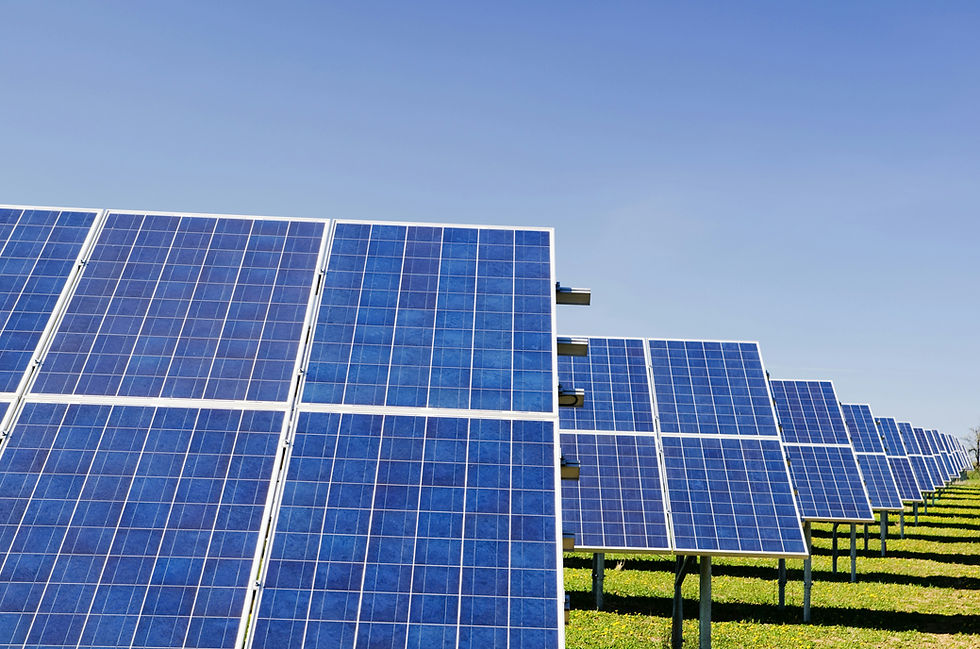
The global commitment towards decarbonisation is clear. Photovoltaic Cells (PV Cells), found on solar panels, are of course a logical transition towards decarbonisation as a clean and sustainable energy source, with plans for large scale solar farms being pushed through to ensure countries are achieving carbon neutrality.
However, the challenge of managing these panels at the end of their Life Cycle remains significant, requiring a framework that addresses their environmental, economic, social, political, and educational impact.
Solar panels generally have a planned lifespan of approximately 25-30 years, as this is when they fall below the 20% less efficiency threshold. Which means that the first wave of solar panels installed in the late 1990’s and early 2000’s are approaching the end of their most efficient life and require replacing. An additional challenge is that ~ 1% can be lost to environmental damage or faults annually.
What happens to PV cell panels that have been replaced is usually one of three options (two are sustainable, one is not):
1. Reuse
2. Recycle
3. Landfill
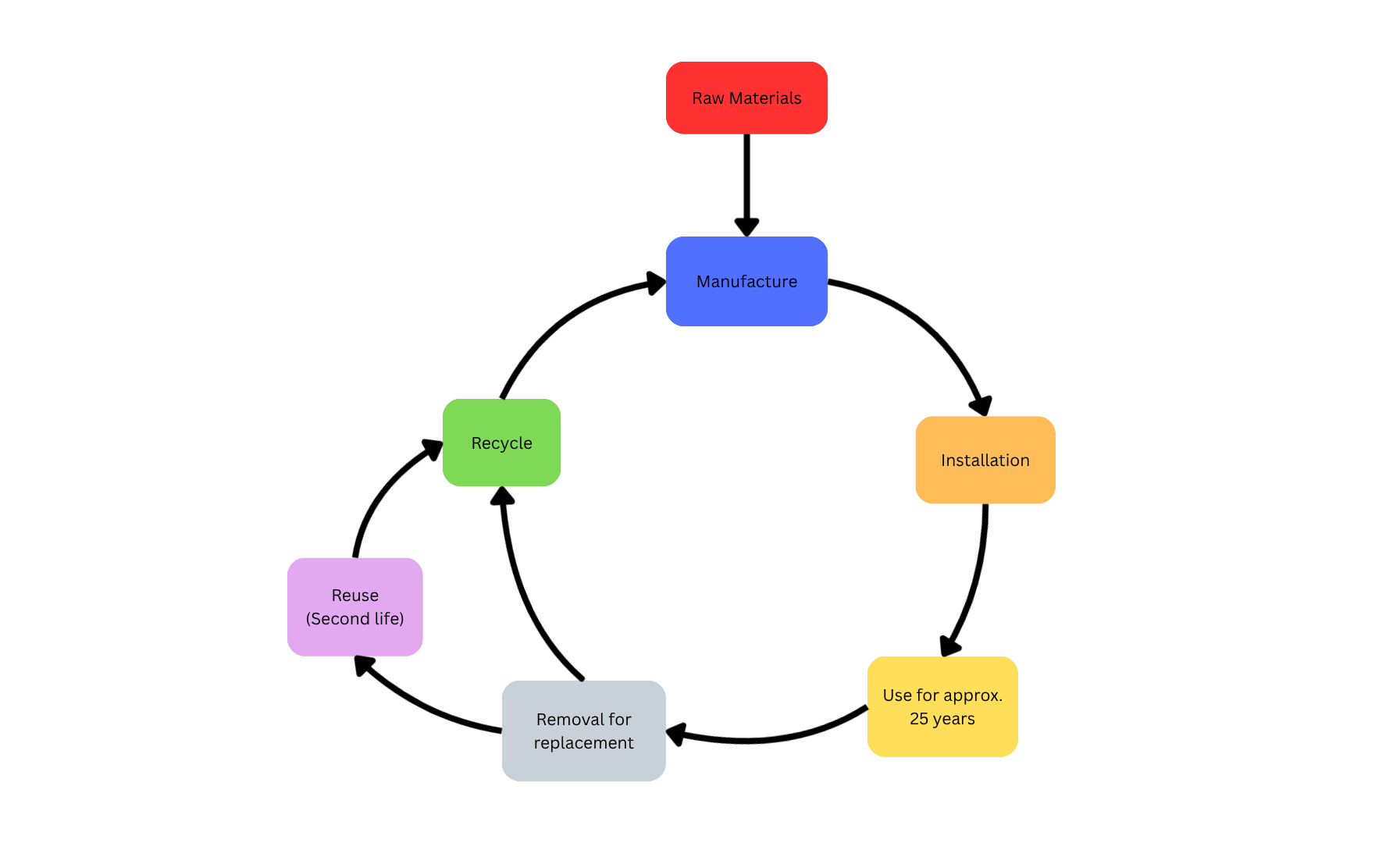
Reuse of solar panels that are no longer at maximum efficiency but could still be viable are being used by remote communities and islands, the responsibility of supply has often challenged this route, it could be a clear opportunity for global charities to help improve the lives of communities and decrease their dependency on carbon rich fuels providing a source of affordable renewable energy for powering a growth in charitable projects. Implementing such a system could have a marked effect on carbon reduction in some of the poorest and most isolated communities.
Once at the end of this “second life” the next sustainable option is for the panels to be recycled.
By recycling panels, we can preserve resources utilised in manufacturing new panels, easing supply chain limitations and reducing the need for raw material mining. Also, prevent the materials used in their creation entering landfill.
Some older panels are toxic due to antimony which currently limits the reuse of this solar glass, more scientific research is required to recover this contaminate, in most cases the metals in solar panels are of sufficient value to warrant the panels recycling.
In the EU and in the UK solar panels now fall under the Waste Electrical and Electronic Equipment (WEEE) directive, that requires solar panel manufacturers to ensure their products can be recycled.
Giving a second life to materials such as glass or aluminium has multiple advantages, for example the glass does not need to go back into a closed loop if it is deemed uneconomic or legislation does not dictate, as other emerging uses such as glass pozzolan (cement) offer a viable, high volume low CO2 use.
Unfortunately, most solar panels are currently not recycled, with estimates suggesting that approximately 10% are recycled globally*. This is largely due to a lack of effective infrastructure, legislation, and the fact that landfilling is often cheaper and allowed by legislation.
While an exact annual global number isn't available, predictions estimate that by 2030, the world could generate 8 million tonnes of solar panel waste, increasing to 60 - 80 million tonnes by 2050.
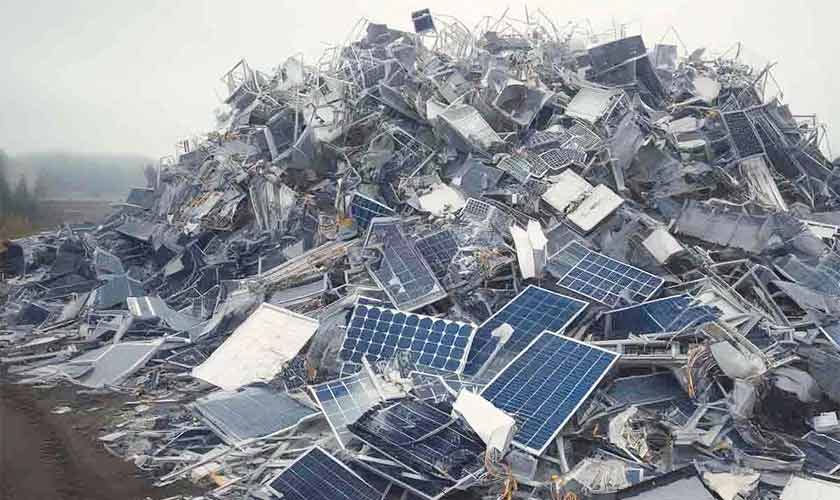
The average composition of a PV cell solar panel includes 78% glass, 10% aluminium, 7% plastic, and 5% metals and semiconductors (silver, copper, silicon). Some panel compositions also contain lead and cadmium which makes proper recycling and avoiding landfill very important.
Are these materials recyclable? Yes. For example, by recovering the aluminium frame and the frontal glass, more than 80-85% can be utilised. Unfortunately, the components of the bonded layers are difficult to extract from used panels, as they consist of several layers bonded together for durability and efficiency. This makes separation challenging for existing recycling technologies, which chiefly entail shredding and thermal processing. And, if not handled properly, discarded panels can leak toxic heavy metals, including lead and cadmium, into soil and water.
There are economic challenges, too. Recycling requires dismantling, collection, transport, and processing. In most cases the economics of recycling require a gate fee to offset the significant investment in technology as well the commercialisation of markets and future R&D.
Different panel designs need specific approaches, eg. materials used in thin film modules differ from those in crystalline silicon panels, and this hinders the development of common standards and industrial processes. Many panel manufacturers are also reluctant to adapt their systems to accommodate supply of recycled components, instead often opting for virgin materials. Put simply, unfortunately if the costs of recycling panels are too high, there’s no financial incentive to do so and the system breaks down, a similar challenge for many materials.

Investing in technology which offers accountability of CO2, while generating high-quality products is paramount. Recycled components could generate 975,000 tonnes of lost CO2, €1.13bn in aluminium, €274m of precious and low conductivity metals, €884m in converting glass to cement, and €13m in EVA, the potential of PV Cell recycling is evident.
Economic asset. The report "End-of-life management; solar photovoltaic panels" from the International Renewable Energy Agency (IRENA)** estimates that the recyclable materials present in obsolete solar panels could become a $15 billion recoverable asset by 2050. Because of this potential Krysteline has collaborated with a number of universities researching methodologies for the deconstruction of solar PV cells.
Krysteline Technologies have developed its process for mechanical deconstruction. A mono shear shredder prepares the glass ahead of the high speed Imploder, the combined systems removing 81% of glass in the first cycle while liberating conductive metals. All material is passed over sophisticated rare earth high intensity magnets to segregate metals. Glass and plastics are passed across a Gyratory Screener to segregate glass sands from plastic, all material passing the Air Lift Channel Feeder for separation of less dense material. The recent addition of low temperature pyrolysis systems has offered commercially viable markets for recovered plastics. The system operates in continuous batch cycles with each circuit having the capacity of 2.5tph, and a modular capacity of 10tph.
Krysteline has been providing technology for processing complex materials for over 20 years, contact us for more information on our PV Cell recycling solutions
References:


Comments